

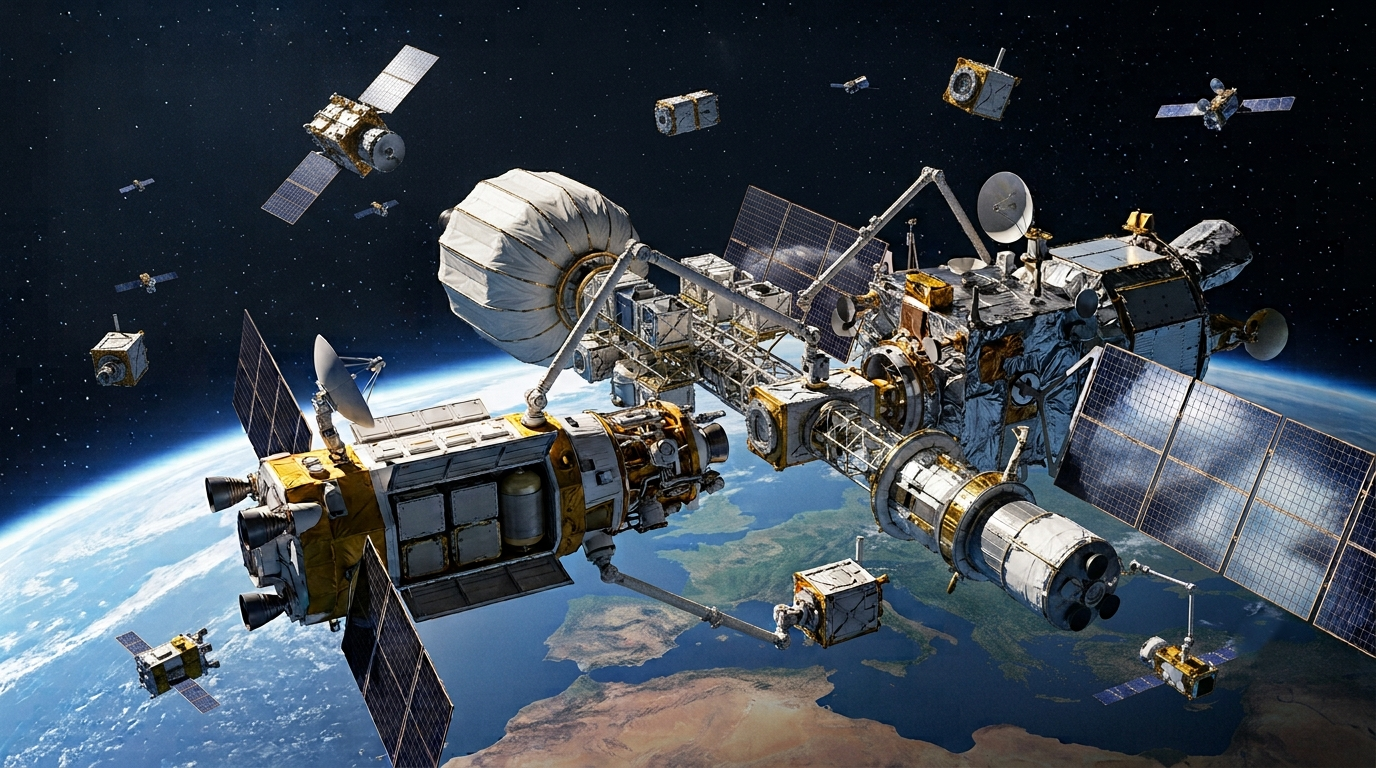
A practical look at how compact-launch, large-deployment architectures can unlock more useful volume and capability in orbit.
The next phase of the space economy will depend on more than launch frequency. It will depend on what missions can do after they arrive. Research, manufacturing, logistics, servicing and sustained human operations all require usable volume, reliable power, protection and interfaces. Those capabilities remain constrained when every system must launch in its final rigid form.
Expandable infrastructure offers a different architectural choice. A structure can be packaged for the launch environment, then deployed or inflated after separation to create a larger operational footprint. The advantage is not volume alone. When expandable modules are designed with deployable power, shielding, docking and pressure-management systems, they can become adaptable platforms rather than single-purpose payloads.
The fairing is a design constraint, not a mission objective
Launch vehicle fairings impose hard limits on geometry. Rigid platforms must fit within those limits while also surviving launch loads, integrating with the vehicle and leaving room for payloads. As missions demand larger laboratories, storage areas or crew-support spaces, simply scaling a rigid structure becomes expensive and mass intensive.
A compact-launch architecture moves part of that complexity into deployment. This creates new engineering requirements, but it can also provide greater usable volume per launch and more flexibility in how a mission grows over time.
Infrastructure is a connected system
An expandable module cannot be treated in isolation. Its value depends on the systems around it. Power must scale with the payload. Protection must reflect the mission duration and environment. Docking and utilities must support integration. Inflation and pressure control must be reliable and verifiable. If samples or manufactured products need to return to Earth, thermal protection and recovery become part of the commercial architecture.
This is why Akashalabdhi is developing a connected technology stack: expandable modules, deployable solar structures, flexible protection concepts, docking interfaces and pressure-management systems. The objective is to reduce the number of disconnected problems a mission partner must solve.
Where the demand is forming
The strongest opportunities sit where additional space and repeatable operations create economic value. Microgravity research needs accessible experiment volume. In-space manufacturing needs stable utilities and logistics. Satellite servicing needs interfaces and support infrastructure. Long-duration and surface missions need protection, power and environments that can be deployed without excessive launch mass.
Not every mission requires the same configuration. The commercial advantage of a modular platform is the ability to adapt the system around the customer’s payload, timeline and risk posture while retaining common architecture across missions.
A disciplined path to orbit
Expandable systems must earn trust through evidence. That means testing materials, seams, deployment behaviour, pressure integrity, environmental performance and subsystem interfaces against a clear verification plan. Ground demonstrators and analogue missions are valuable because they reveal operational and integration issues before flight. They do not replace qualification, but they make the flight programme more informed.
The orbital economy will be built by teams that turn ambitious architectures into testable, partner-ready systems. Expandable infrastructure matters now because it gives missions a practical way to grow beyond the dimensions of launch while preserving a disciplined path from prototype to deployment.